|
|
|
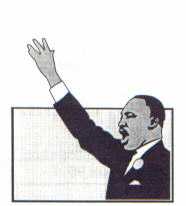
"He stood for peace and love all over this land . . ." |
|
|
|
|
"He stood for peace and love all over this land . . ." |
|
PREFACE
This article first appeared in the January 1998 edition of
Imani Tidings. In my references to People of Color, this writer prefers to use the
identifier of "Black". This choice is preferred because (1) all Black people
may have roots on the African Continent, but not all Black people are American and
(2) reference to Black suggests a "universal" kinship to Black people everywhere.
I remember very clearly having to go with my mother to a PTA meeting once for
my younger sister when she was in elementary school. It was in February during what
was then Negro History Week. I remember the sister of one of my sister's classmates,
a little girl by the name of LaMont, singing a song with the words "He stood
for peace and love all over this land . . . Martin Luther King, was a great, great
man . . . ". I remember the conviction in the voice of my sister's little friend,
how proud she was of herself for singing that song, and how proud everyone else was
for hearing it. Though I can't remember the exact year of this great performance,
I do remember that it had only been just a couple of years (give or take) since Dr.
King had been killed by a sniper's bullet at a hotel in Memphis, Tennessee.
Some
of us remember what it was like to walk down streets paraded by the KKK -- and having
your mother snatch you along trying to avoid the threat of any possible confrontation.
Some of us had statues of confederate soldiers in our home towns that were given
more respect than the local black clergy. And some of us still remember the signs
that said "NO COLORED ALLOWED". Some of us will never forget.
Not
very long ago I was in a restaurant with some friends and there was a group of young
people sitting at a table across from us. Although we were not in any way eaves dropping,
we did over hear their rather loud conversation about the present state of race relations
and their feelings on how much progress had taken place since the 1960's. One of
them commented that she felt race relations would have been forced to improve, even
if the "King era" had never happened because it would have eventually,
more or less, faded away. Apparently, her lunch partners, all black, agreed. While
my initial reaction was one of indignation, I reminded myself that young people their
ages just do not have a clue. It is indeed difficult to understand how things were
when you have not had the first hand experiences. Yet, it is all the more tragic
that our young people are really kind of out of touch about an episode of American
History that was very traumatic to say the least, and for many is still an issue
that re-opens very deep and very sensitive wounds. I feel certain that all of those
young people at least had grandparents that were affected by what many of us have
decided to call apartheid in America.
To me, it seems that in the eyes of
some, Martin Luther King, Jr. has become somewhat of a cliché. Usually, when his name
is mentioned, our automatic thinking reverts to the Civil Rights Movement, and subsequently,
to non-violence and civil disobedience. But when you get right down to it, not much
has really changed, particularly in terms of people's attitudes about race and racism.
And to exacerbate the matter as far as America is concerned, we haven't solved the
black/white issues in this country and now we've gone and added two more minority
groups -- Asians and Hispanics. For some of us it may be a rude awakening, but no
longer can the "Black Man" claim the title as THE minority in America.
And there are many subtle moves --privately, publicly and politically -- that are
slowly but surely nibbling away at much of the little progress that has been made
in the name of Civil and Equal Rights. Not only that, but many of the so-called malitia
groups are nothing more than updated versions of the KKK and other white supremecist
factions. We must maintain our awareness of these past and current trends and be
mindful of future trends and how these kinds of subtle changes can ultimately affect
us.
Martin Luther King was about peace, justice and love. I believe that he
knew the risks and that he accepted those risks because of his faith in God and his
love for his fellow man. I believe that for Dr. King, life itself was a matter of
loving all people and standing up for the equality of every human being. I believe
that had he known a holiday would be designated on his behalf he would have wanted
to see people working together, side by side, hand in hand. I believe that Dr. King
had a "dream" much like John, of an earthly multitide coming up from every
nation (Revelation 7:9), and perhaps that was some of what motivated him in striving
for Civl Rights. But I also believe he realized that in order to love others, we
have to love ourselves as well. I believe that Dr. King's message to the world included
an admonition of self love as well as brotherly love.
And so because of this,
it is quite fitting that the holiday honoring The Rev. Dr. Martin Luther King, Jr.
comes two weeks in advance of a month long celebration and observance where Black
Pride and Black History is the focus. Let us all be encouraged to recognize the holiday
of Dr. King with an awareness that in these "difficult days" we must maintain
the "Strength to Love".

Copyright,
R.D. Fitch, 1999. All rights reserved.
For questions about this website, contact
site administrator,
Rev. Rae D. Fitch, hamongirl@aol.com.
